The research of the Systemic Futures Lab is organised around the study of systemic disruption, organisational resilience, operational continuity, cascading risk, high-impact low-probability events, and scenario-based stress testing.
The research is driven by practical questions: how can organisations prepare for both the known and the unknown? How can they adapt and recover as crises evolve? How can disruption escalate? And what capability is needed when normal arrangements are no longer enough?
This page brings together the Lab’s research themes, conceptual foundations, methods, and baseline references.
The Lab’s research is developed and tested through funded projects including AGILE, CLOSER, CIRCLE, and EO4MULTIHAZARDS, which provide the applied setting for translating conceptual foundations into practice-facing outputs. View our projects.
Conceptual foundations
The Lab’s research is grounded in the study of how disruption moves through complex systems.
Our conceptual work is not developed as theory for its own sake. It is designed to support practice: to define system dynamics, identify vulnerability pathways, recognise escalation points, and translate these insights into methods that can be used by organisations, policymakers, and practitioners.
A central part of this work is the analysis of cascading risk, tipping points, compound risk, interconnected risk, interacting risk, systemic disruption, and their recombination in high-impact low-probability events. These foundations are operationalised through scenario building, capability assessments, resilience stress testing, and risk- or threat-agnostic approaches.
They help explain why disruption rarely remains confined to a single hazard, sector, organisation, or infrastructure. They show how failures propagate, how dependencies amplify impacts, and how assumptions break down when systems are under pressure.
The value of these foundations is practical. They inform scenario design, stress testing, dependency analysis, continuity planning, training exercises, policy evidence, and frameworks for preparedness, adaptation, and recovery. In other words, the Lab uses research to make system dynamics visible, testable, and usable.
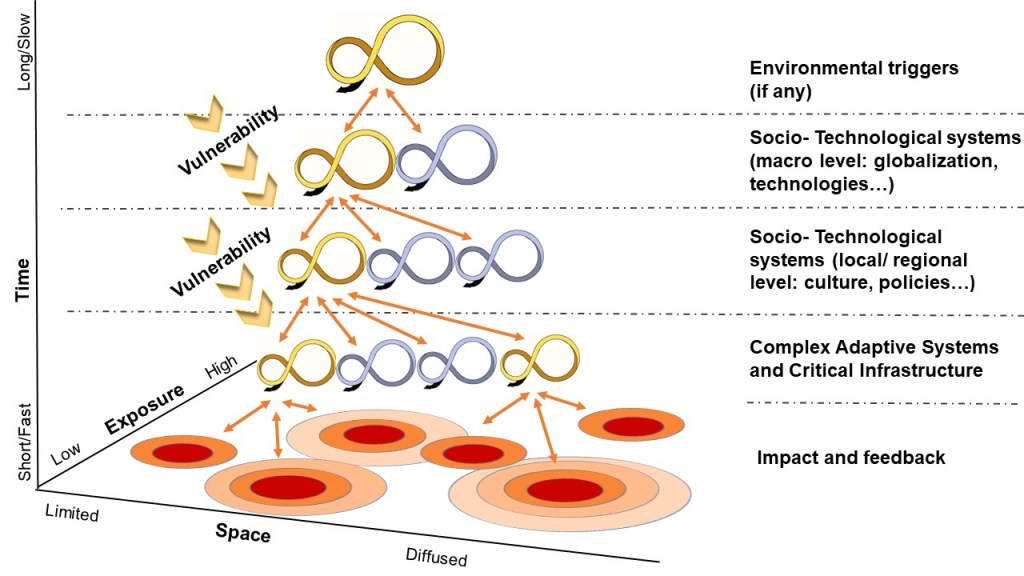
Figure 1. Different scales, feedbacks and vulnerability paths in cascading events (Pescaroli and Alexander 2016)
Methodologies
The Lab uses mixed-method research to turn systems thinking into practical preparedness.
We combine qualitative and quantitative data collection, case analysis, scenario building, and stress testing to understand how disruption escalates, where systems are vulnerable, and what capability is needed when normal arrangements are no longer enough.
The focus is practical: testing assumptions, identifying single points of failure, prioritising what must continue, and supporting adaptation and recovery as events evolve.
Baseline references
The Lab’s work builds on baseline publications on cascading risk, systemic disruption, high-impact low-probability events, resilience stress testing, and risk- or threat-agnostic resilience:
- Pescaroli, G. and Alexander, D. (2016). Critical infrastructure, panarchies and the vulnerability paths of cascading disasters. Natural Hazards.
- Pescaroli, G. and Alexander, D. (2018). Understanding compound, interconnected, interacting, and cascading risks: a holistic framework. Risk Analysis.
- Pescaroli, G., Wicks, R. T., Giacomello, G. and Alexander, D. (2018). Increasing resilience to cascading events: The M.OR.D.OR. scenario. Safety Science.
- Pescaroli, G., Guida, K. and Alexander, D. (2023). Managing systemic risk in emergency management, organisational resilience and climate change adaptation. Disaster Prevention and Management.
- Linkov, I., Trump, B. D., Trump, J., Pescaroli, G., Hynes, W., Mavrodieva, A. and Panda, A. (2022). Resilience stress testing for critical infrastructure. International Journal of Disaster Risk Reduction, 82, 103323.
- Trump, B. D., Mitoulis, S. A., Argyroudis, S., Kiker, G., Palma-Oliveira, J., Horton, R., Pescaroli, G., Pinigina, E., Trump, J. and Linkov, I. (2025). Threat-agnostic resilience: Framing and applications. International Journal of Disaster Risk Reduction, 124, 105535
- Pescaroli, G., McMillan, L., Gordon, M. and others (2025). Definitions and taxonomy for High Impact Low Probability (HILP) and outlier events. International Journal of Disaster Risk Reduction.

