The Systemic Futures Lab is a research and practice platform focused on helping organisations turn resilience into practical capability.
The starting point is simple: we cannot predict everything, but we can prepare better. Disruption rarely follows the boundaries of plans, departments, sectors, or risk registers. Events escalate through dependencies, wrong assumptions, coordination gaps, and single points of failure that often remain hidden until systems are under pressure.
The Lab works across organisational resilience, operational continuity, crisis management, systemic risk, scenario-based stress testing, and socio-technical systems. Its work focuses on how organisations prepare for disruption, how disruption escalates, and how cascading effects can affect infrastructures, services, supply chains, governance systems, and communities.
Our work is applied. We develop research, training, exercises, frameworks, and stakeholder-facing outputs that help organisations prepare for known risks, emerging threats, and uncertain futures.
Our mission
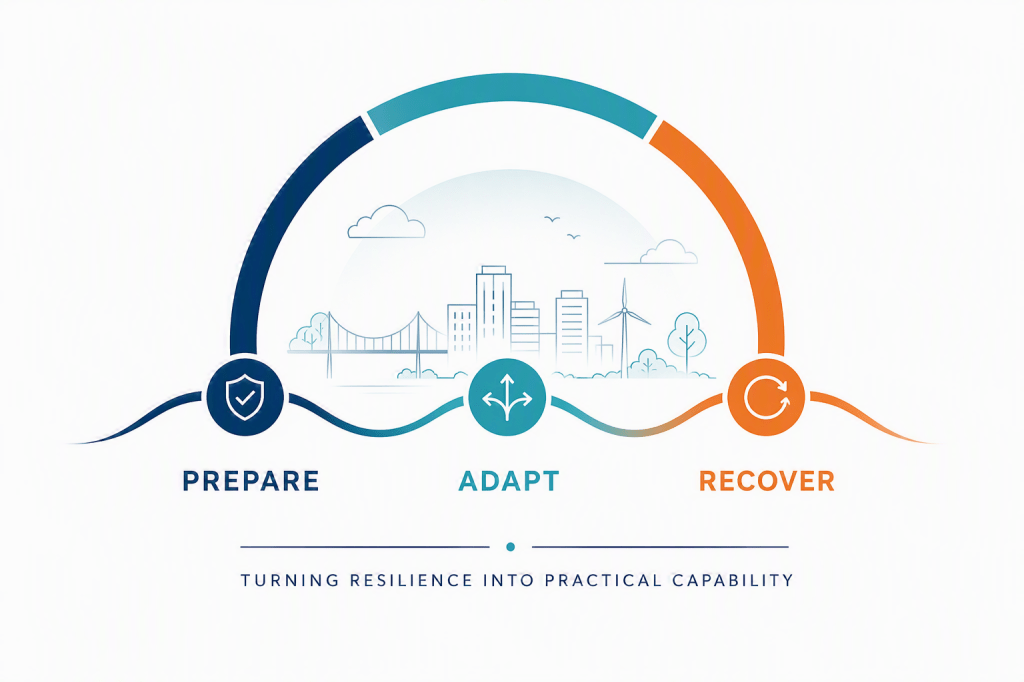
Our mission is to help organisations prepare before disruption becomes crisis, and recover faster by adapting as events cascade and evolve.
We develop actionable knowledge, methods, training approaches, and practical tools that support continuity, preparedness, recovery, and decision-making under uncertainty.
The Lab works with public authorities, private sector organisations, civil protection actors, infrastructure operators, resilience professionals, researchers, and civil society stakeholders.
The aim is not to make resilience a slogan, but to make it usable in practice.
Why the Lab matters
Organisations need to prepare for the risks they know, and for the disruptions they cannot fully predict. This requires a shift in mindset: resilience cannot remain an aspiration or a static plan. It needs to become a practical capability.
Some events have familiar triggers: extreme weather, cyber disruption, infrastructure failure, supply chain disruption, health emergencies, geopolitical instability, or organisational breakdown. Others emerge from high-impact, low-probability events, unexpected combinations of known risks, weak signals, dependencies, or cascading effects that only become visible when systems are already under pressure.
The challenge is not only to identify possible hazards. It is to build the capability to continue, adapt, and recover as the situation changes, while focusing resources on what matters most, independently of the scenario that develops.
This is where the Systemic Futures Lab focuses its work: helping organisations move beyond static plans and develop practical capability for uncertainty. This means understanding what must be prioritised, where dependencies exist, what could fail first, how disruption may escalate, and what decisions are needed when normal arrangements are no longer enough.
The aim is to help organisations prepare not only for specific threats, but for the conditions that allow disruption to escalate, cascade, and become systemic.
Our approach
The Systemic Futures Lab takes a systemic and risk- or threat-agnostic approach complementary to the one of developed by other teams
Rather than starting only from individual hazards, the Lab looks at vulnerabilities, dependencies, escalation pathways, common points of failure, and organisational capabilities that matter across different types of disruption.
This approach complements existing work on risk, infrastructure, and resilience by focusing on the practical capabilities organisations need when disruption does not follow the expected scenario.
It is particularly important for high-impact, low-probability events. These events may be rare, surprising, or poorly represented in existing planning assumptions. They may also emerge from familiar hazards that combine or escalate in unfamiliar ways.
The Lab is interested in the point where disruption becomes systemic: when one failure creates pressure elsewhere, when coordination becomes harder, when assumptions break, and when organisations need to adapt quickly.
The same perspective applies to recovery. Faster recovery depends on understanding how disruption has evolved, which functions remain under pressure, where new dependencies have emerged, and what decisions are taken.
For more detail on our research themes, methods, publications, and project outputs, see our Research page.
Networks and collaborations
The Systemic Futures Lab works with a wider network of collaborators and partner initiatives across academia, policy, public sector organisations, private sector stakeholders, international organisations, resilience professionals, and civil society.
We are proud to contribute toof the UCL Centre for Global Infrastructure Resilience (GYROS), bringing a focus on organisational resilience, operational continuity, crisis management, systemic risk, and the soft infrastructure that determines how systems perform under stress. See: www.ucl.ac.uk/bartlett/construction/research/virtual-research-centres/centre-global-infrastructure-resilience
We work in close collaboration with the Cambridge Centre for Risk Studies, University of Cambridge, connecting our work on organisational capability, cascading disruption, and stress testing with wider research on systemic threats and risk. See: https://www.jbs.cam.ac.uk/centres/risk/
We also support the work of the United Nations Office for Disaster Risk Reduction, advising the Corporate Network of Chief Resilience Officers, helping bridging research on resilience with practical challenges faced by organisations and business leaders. See: https://www.undrr.org/implementing-sendai-framework/catalyze-investment-in-resilience/corporate-chief-resilience-officers-network
For an overview of our previous and current partners in research, please refer to our projects.

